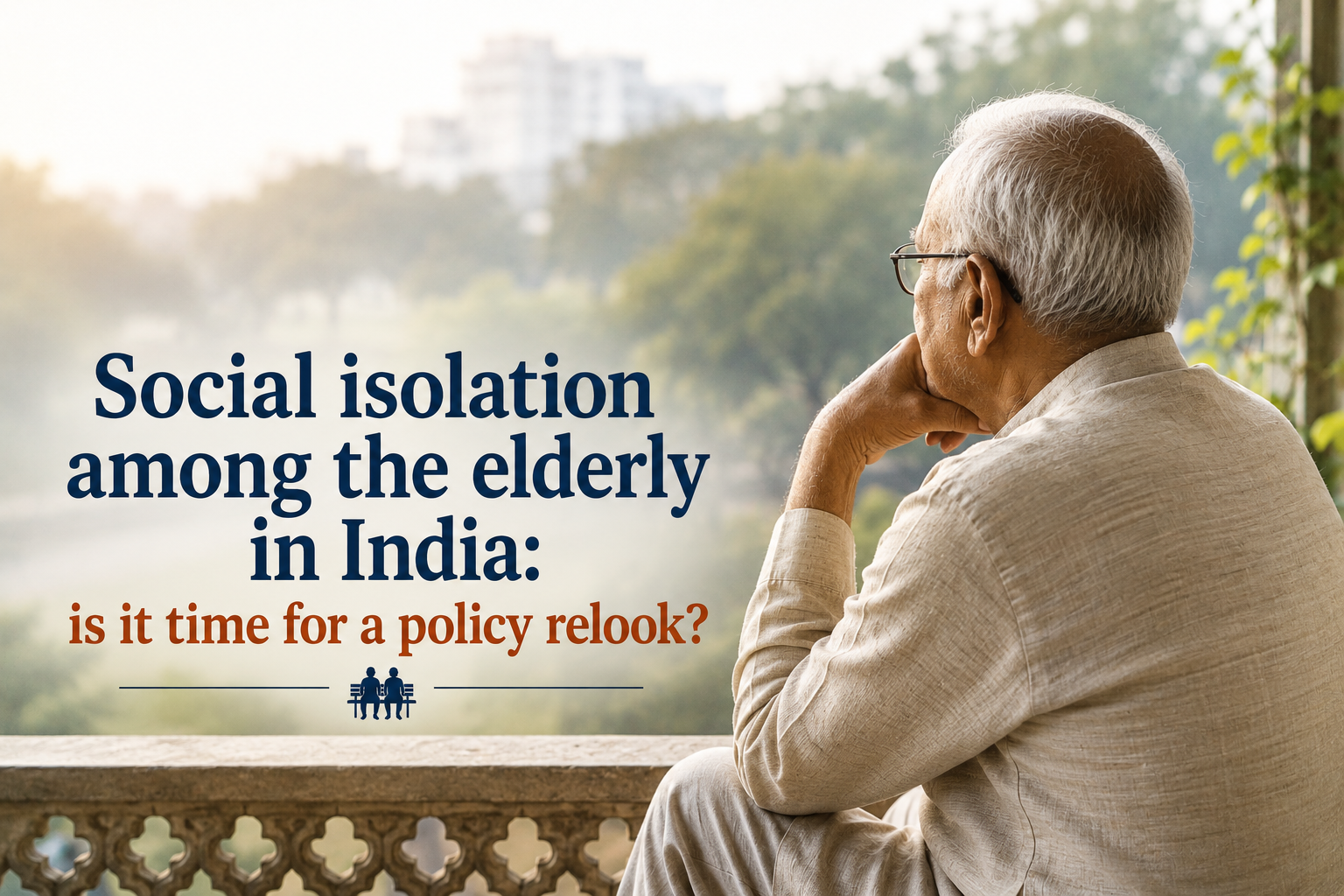
There is a demographic shift taking place in India. The ageing population is steadily growing as a result of advances in healthcare, longer life expectancy and declining fertility rates. The government estimates that by 2050, India will have more than 300 million older people. Longevity is an amazing accomplishment but it can also be a challenge that is seldom discussed openly-social isolation of the elderly.
Social isolation is a more than living alone. It means there are not meaningful social connections, participation in community life is limited, and emotional support is limited. It is a silent epidemic for many older adults which impacts on their mental, physical and emotional health. India is becoming an ageing society and it is high time it revisits the existing method of care for the elderly and emphasizes on promoting social connectedness.
In the past, joint families were the source of companionship, care and purpose for the older people of India. Elders were actively involved in family decision making and in childcare, maintaining their social involvement. But the changes brought about by the fast process of urbanization, migration, nuclear families and change in lifestyle have changed this.
Young adults are increasingly leaving villages and small towns for cities or foreign lands for education and work, while their ageing parents remain in the village and small towns. With busy work schedules and digital distractions, meaningful interaction is often not possible even when elderly parents live with their children. This means that for many older people loneliness occurs despite the fact that they have people around them.
Social isolation is not a problem only of feeling lonely; but it is a serious public health problem. Loneliness has been associated with depression, anxiety, cognitive decline, cardiovascular diseases and lowered immunity in studies which have been conducted consistently. Social isolation in older adults is associated with reduced quality of life and greater risk of death.
The emotional toll can be overwhelming. When elderly people feel that they are a burden to their families, feelings of abandonment, helplessness and worthlessness can arise. The death of a spouse adds to a senior's sense of loneliness, especially for those who have lived alone for years. When a senior loses a spouse, it can make them feel even lonelier, particularly if they have been living alone for many years. In the worst situations, social isolation can lead to suicidal ideation and severe mental illness.
The economic consequences are also not to be taken lightly. When older adults are socially isolated, their health care needs are greater, which adds to the demands on families and health care systems. Hence, the need to help with social isolation is not only a social issue, it is an economic need.
India has launched various schemes for the welfare of the elderly such as pension schemes, healthcare schemes and Maintenance and Welfare of Parents and Senior Citizens Act. Though financial and legal safeguards exist, social well-being is not always accounted for.
Most current policies are targeted at income supports and access to health care. Emotional health, participation in the community, and social inclusion are however comparatively under-invested. Limited investment in programs is in the community that promotes interaction, recreation, and life-long involvement among older adults.
Furthermore, the population of elderly people in rural areas is in a specific situation. Insufficient transportation, lack of digital literacy skills and lack of recreational facilities often leave them without the ability to maintain social networks. Elderly women are even more at risk than other elderly persons because of their economic dependency and social exclusion.
Digital technologies can help to decrease social isolation. Stay social with family and friends via video calls, social media, telehealth and online communities. Technology was an important lifeline for many seniors during the COVID-19 pandemic.
But there is a digital divide that is still a major challenge. Older adults often do not have access to cell phones, Internet or the ability to use digital platforms. Digital literacy can exacerbate inequalities if not addressed through targeted programmes.
It is important that age-friendly digital training programs are put in place and funded by government and civil society organizations to enable and support seniors to confidently engage in the digital world. The role of technology is to supplement, not supplant, human interaction.
It was clear that the community was in need of solutions. It was evident that community-centred solutions are needed.
Social isolation must be tackled from a perspective which goes beyond medical or welfare issues. It is important that communities are engaged and active partners in healthy aging promotion.
Senior activity centres, community clubs and intergenerational programs can provide opportunities for meaningful engagement. There are opportunities for schools and colleges to engage with older people regularly through volunteering, storytelling and mentoring programs.
These developmental opportunities not only help seniors, but also promote empathy and social responsibility among younger generations.
Age-friendly public places where older people can meet, play and enjoy culture can be created. Spending time together during regular health camps and social gatherings as well as recreation programs can help foster a sense of community and counteract a sense of loneliness.
Social connectedness needs to be acknowledged as a factor in having a healthy aging in a comprehensive policy response. Loneliness and social isolation should be part of the routine assessment of all older people in health and social care. Primary healthcare workers, community health volunteers and social workers can be used to detect people at risk and help them to access support services.
Healthcare providers, local governments, non-governmental groups and community groups should work together; policy frameworks should promote this. It is crucial to have dedicated funding for social participation programmes, mental health services and to create suitable infrastructure for the elderly.
Besides this, older people's voices need to be incorporated into the process of policy making. Older people are not just "users of services", but also valuable contributors to society who can inform effective solutions with their experiences and insights.
India is at a juncture. The country has to go beyond the traditional approaches of health and money when it comes to the issue of aging. Social isolation is an invisible, but significant, problem which is eroding the dignity, health and well-being of millions of older people.
There is an urgent need to relook the policy, which should acknowledge the importance of social connectedness as an integral part of healthy ageing. The investments in community engagement, digital inclusion, mental health support and age friendly environment can help India ensure that older people don't simply live longer, but live better.
The true standard of a society is its treatment of old people. A vision of an older adult who is valued, connected, and respected is not just stated in policy, but it is moral and a goal to be pursued.