
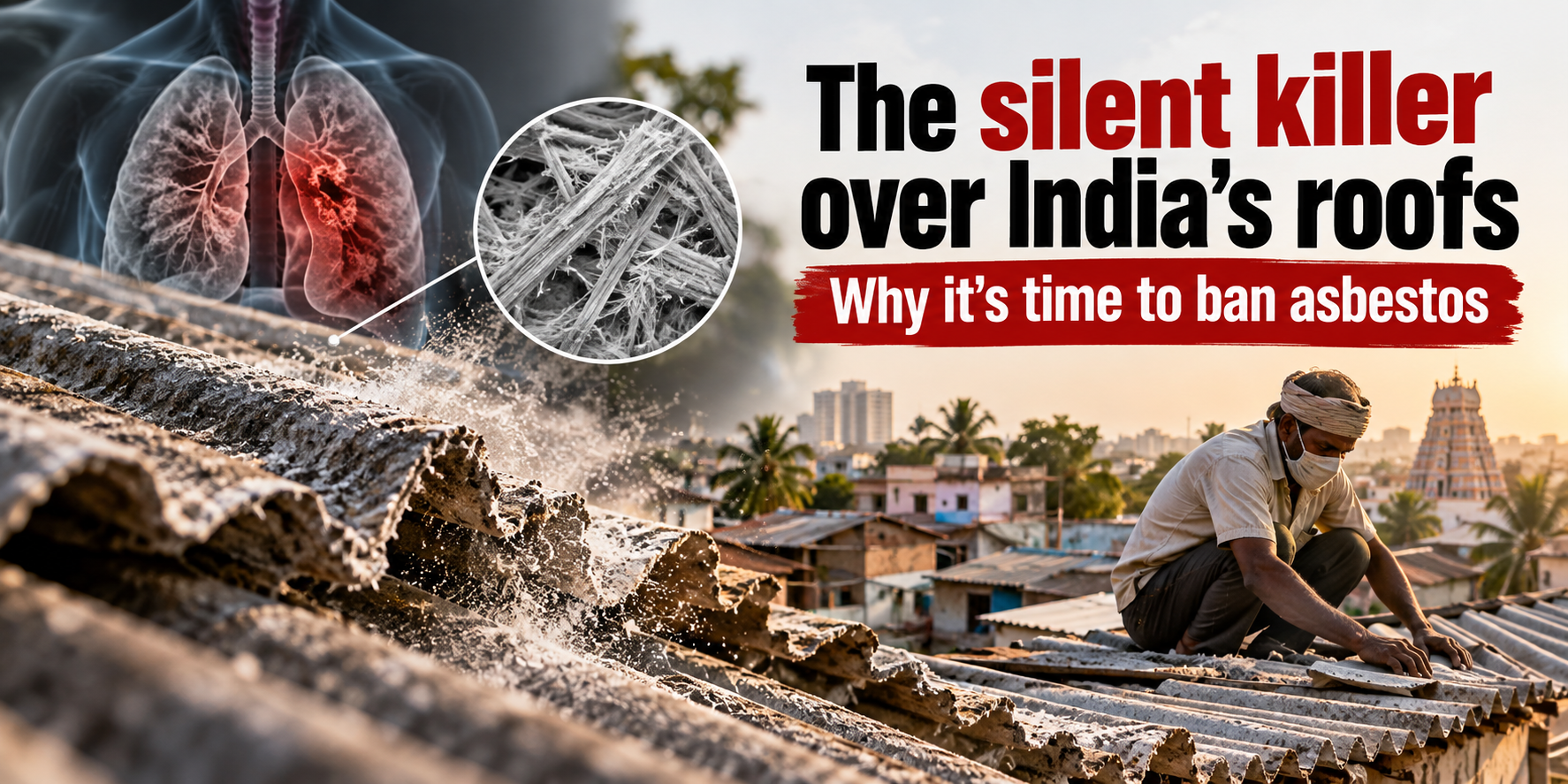
Every year, somewhere in India, a man in his fifties begins to cough and does not stop. He may have worked in a cement-sheet factory, broken ships on the beaches of Alang, or simply lived for decades under an asbestos roof. His doctor may call it tuberculosis or chronic bronchitis, when viewed from a differential diagnosis lens butit is often neither. It is the delayed effect of a mineral that more than 65 countries have banned, and that India still imports in large quantities.
The scientific debate on asbestos has been long established. The International Agency for Research on Cancer classifies all forms of asbestos, including chrysotile (“white asbestos”), as Group 1 human carcinogens. The World Health Organization states plainly that there is no safe threshold of exposure and that the most efficient way to eliminate asbestos-related disease is to stop using all types of asbestos. Global estimates published at various forums puts asbestos-related deaths at more than 3,00,000 per year, from mesothelioma, lung cancer, asbestosis, and cancers of the larynx and ovary. Because these diseases can take 20 to 50 years to appear, the fibres used today are a debt to be paid in 2060s. The Indian Government’s own notification under Section 25(1) of the Mines Act, 1952, recognises the diseases that can be caused by asbestos, which demonstrates that imminent danger exists.
India stopped granting new asbestos mining leases decades ago, and in Consumer Education and Research Centre Vs Union of India (1995) the Supreme Court of India held that the health of asbestos workers is protected under Article 21’s right to life. Yet India remains one of the world’s largest consumers of chrysotile, imported largely from Russia and Kazakhstan. Most of it goes into asbestos-cement roofing sheets, sold cheaply to the poor, to rural schools, and to informal settlements, putting vulnerable populations at risk.
The industry’s defence rests on controlled use, the claim that chrysotile can be handled safely under regulation. Lessons from other countries demonstrate otherwise. Controlled use may be possible in a well-inspected factory, but asbestos does not stay in the factory. Roofing sheets are cut, drilled, broken in storms, demolished, and dumped. Tens of millions of Indians work in the informal sector, wherein use of masks, wet-cutting, and medical monitoring are rather rare. The ship-breaking yards of Alang are a clear warning. A Supreme Courtappointed technical committee in the mid-2000s reportedly found signs of asbestosis in about one in six workers it examined. Official records, by contrast, register strikingly few asbestos-disease cases nationally. That gap is not evidence of safety. It is evidence of under-diagnosis and blissful ignorance given the volume game and conflicting priorities of safety standards.
International case studies show where the safe use path leads. In Casale Monferrato, Italy, home to an Eternit asbestos-cement plant, mesothelioma killed not only workers but their wives, who washed dusty overalls, and townspeople who never entered the factory. The resulting prosecutions became some of the longest-running criminal trials in European history. Eric Jonckheere in this book titled “Asbestos – My war with the Devil’s dust” morefully explains the devil in the details and how parts of Europe came around to ban asbestos.
In Wittenoom, Australia, a blue-asbestos mining town, the harm was so severe that the town was eventually wiped off official maps. Millions of tonnes of toxic asbestos tailings were left exposed across 46,000 hectares. Inhalation of microscopic fibers led to high rates of terminal lung diseases and cancer, with an estimated 80% of former residents dying from asbestos-related illnesses. Australia banned all asbestos in 2003 and now spends heavily on removal. In Libby, Montana, contaminated vermiculite mining caused a public-health emergency. The United States after significant reluctance and judicial push-backs finally banned ongoing uses of chrysotile.
Asia now accounts for the majority of global asbestos consumption, which is why India’s choice matters beyond its borders and will have an influence on global trade diplomacy and sustainability to emerge as a regional anchor in progressive commerce. Sri Lanka had initiated a ban in 2016 and then retracted it due to trade pressure from allies. India needs to stop resisting listing chrysotile under the Rotterdam Convention’s prior informed consent procedure which will reflect the serious effort towards alternative trade and influence regional diplomacy to a greater extent, not to mention putting her people first.
A credible Indian ban as a policy decision would include a firm phase-out date for imports and manufacturing, transition support for workers and small manufacturers, a national programme for identifying and safely removing asbestos roofing, starting with schools and hospitals, and a registry to diagnose and compensate victims. The cost of acting now is real but finite. The cost of waiting grows with every sheet installed.India has shown on singleuse plastics and leaded petrol that it can phase out harmful materials. Asbestos is a far deadlier case having devasting consequences sweeping generations. By banning it, India would protect its own workers and families, and it would show a continent that development does not have to be built under a carcinogenic roof. This would mark a significant win for Indian diplomacy as well.